What is scleroderma?
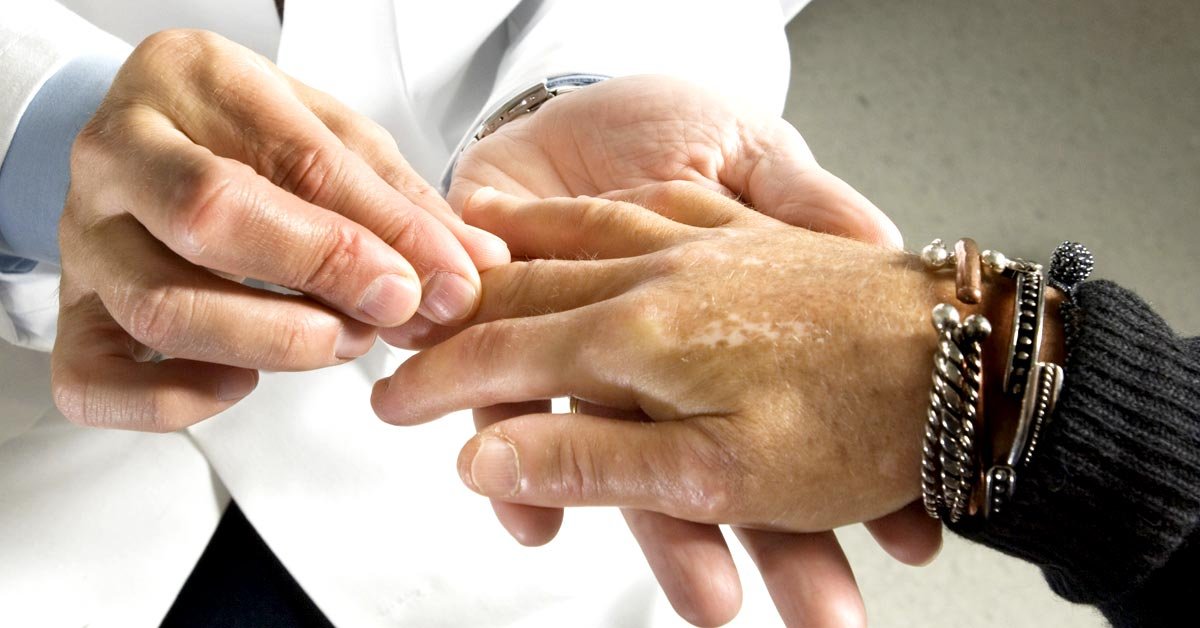
Scleroderma is a rare chronic disease of the immune system, blood vessels and connective tissue. Around 2.5 million people worldwide live with scleroderma. There is no patient register for this disease in Bulgaria, but various sources suggest there are around 500 people with it. “Scleroderma” comes from the Greek “sclero”, meaning hard, and “derma”, meaning skin. It is an autoimmune condition, which means that the immune system becomes overactive and attacks healthy tissue in the body. Hardening of the skin can be one of the first noticeable symptoms, because the body produces too much collagen. This excess collagen can affect the skin, joints, tendons and internal organs. It causes damage that prevents the affected parts of the body from working normally.
Symptoms
The course of the disease is different for every patient. It depends on the type of scleroderma, how severe it is and which parts of the body are affected.
Skin changes
For most people, scleroderma causes skin problems. These symptoms can include:
- patches of thickened, hard skin, which may become discoloured
- itching
- tight skin that makes it difficult to move the joints
- hard lumps under the skin (calcinosis)
- visibly widened small blood vessels (spider veins) appearing just under the skin, called telangiectasia
You can develop painful sores on the tips of the fingers and toes, called digital ulcers. These need to be treated straight away to protect the tissue and prevent infection.
Raynaud’s and scleroderma
Along with scleroderma, it is common to have a condition called Raynaud’s syndrome/phenomenon. People with Raynaud’s are sensitive to temperature changes or cold, because Raynaud’s phenomenon is a process in which blood flow is restricted, most often in the fingers and toes and less often in other parts of the body such as the ears and nose. The affected parts of the body, most often the fingers or toes, go through three phases of colour change (white, blue, red). Stress and anxiety can sometimes be a trigger.
Types of scleroderma
Scleroderma is divided into two main forms: localised scleroderma, which affects only the skin and the tissue under the skin, forming one or more hardened patches, and systemic sclerosis, which affects the skin and the internal organs. It can involve the heart and the oesophagus, as well as the blood vessels, kidneys, lungs and digestive system.
Localised scleroderma
Morphoea is the name given to localised patches of hardened skin that look smooth and shiny. They usually appear on the trunk, but can affect any part of the body. The condition is not painful and there are usually no other symptoms or additional problems. Several main forms of morphoea have been described: circumscribed morphoea, which is divided into superficial and deep subtypes, generalised morphoea, pansclerotic morphoea, and idiopathic atrophoderma of Pasini and Pierini. Lichen sclerosus can also be included here: patients with morphoea, especially post-menopausal women, can develop skin changes that resemble lichen sclerosus in the genital area. In addition, morphoea lesions can exist at the same time as lichen sclerosus on the body. For this reason, people with lichen sclerosus should be examined for signs of morphoea, and those with morphoea should be checked for lichen sclerosus.
“Linear” scleroderma means that the skin is affected in a line, usually along an arm or a leg. The skin looks shiny, discoloured or scarred and often feels tight and uncomfortable. In children this needs to be monitored carefully, because the continuing growth of the limbs may be affected.
“En coup de sabre” literally means “cut of a sword”. This form of linear scleroderma appears on the scalp and temple, mostly in children. If the affected area is limited to the scalp, the problem is mainly cosmetic, although the underlying bone may be affected. Many patients also have involvement of the central nervous system in addition to the skin.
Parry-Romberg syndrome (progressive facial hemiatrophy) is also thought to possibly be a variant of localised scleroderma, but the exact cause and mechanism of this disease remain unknown. It affects children between 5 and 15 years of age and appears on the face, usually on only one side (hemifacial atrophy), but sometimes spreads to other parts of the body. It can affect the growth of the facial bones. In addition to the connective tissue disease, the condition is sometimes accompanied by neurological, eye and oral symptoms. The range and severity of the associated symptoms and findings vary greatly.
Systemic sclerosis
Systemic sclerosis in turn is divided into two types: limited and diffuse. Limited systemic sclerosis may be preceded for years by Raynaud’s phenomenon before scleroderma appears, mainly on the hands, forearms, feet and legs below the knees, and less on the face and neck. The lungs and digestive system can become involved over time.
Diffuse systemic sclerosis is characterised by diffuse skin sclerosis, i.e. involvement of the skin of the whole body and of various internal organs (heart, lungs and kidneys), and in some cases there can be potentially serious complications. Common symptoms include fatigue, joint pain and stiffness.
Sources:
https://pubmed.ncbi.nlm.nih.gov/30758333/ https://en.wikipedia.org/wiki/Parry%E2%80%93Romberg_syndrome Lichen sclerosus – diagnosis and treatment | Puls.bg https://www.puls.bg/aktualno-c-6/likhen-sklerozus-diagnostika-i-lechenie-n-40879 “Consensus on progressive systemic sclerosis”, Bulgarian Society of Rheumatology, March 2019
This English version is a translation; in case of doubt, the Bulgarian version applies.